

Just leave people the hell alone
We are talking about the assault on women, minorities, and LGBTQ communities like they are niche 'culture wars' but they are direct attacks on freedom

Freedom is simple
I’ve always seen the basic principle of this country as the simple one laid out in the very first line of the Declaration of Independence: “We hold these truths to be self-evident, that all men are created equal, that they are endowed by their Creator with certain unalienable Rights, that among these are Life, Liberty and the pursuit of Happiness.”
That statement didn’t have an asterisk. There was no hesitation written in it but we have spent the 250 years since fighting for it’s realization. Even now many in our nation fear for their freedom.
It’s shocking how a whole new assault on our rights is occurring across the nation as the Supreme Court has opened the flood gates for assaults on the voting rights act, women’s healthcare, and LGBTQ rights and Republican controlled states have pounced.
I had the opportunity to sit down with Heather Brown-Hudson for ‘Out in STL’ a week ago to discuss my race and the LGBTQ community. I’ve copied it here so you can see where I stand and how the pursuit of that simple guide 250 years ago that all men are created equal, animates my politics today.
Here is the article in full:
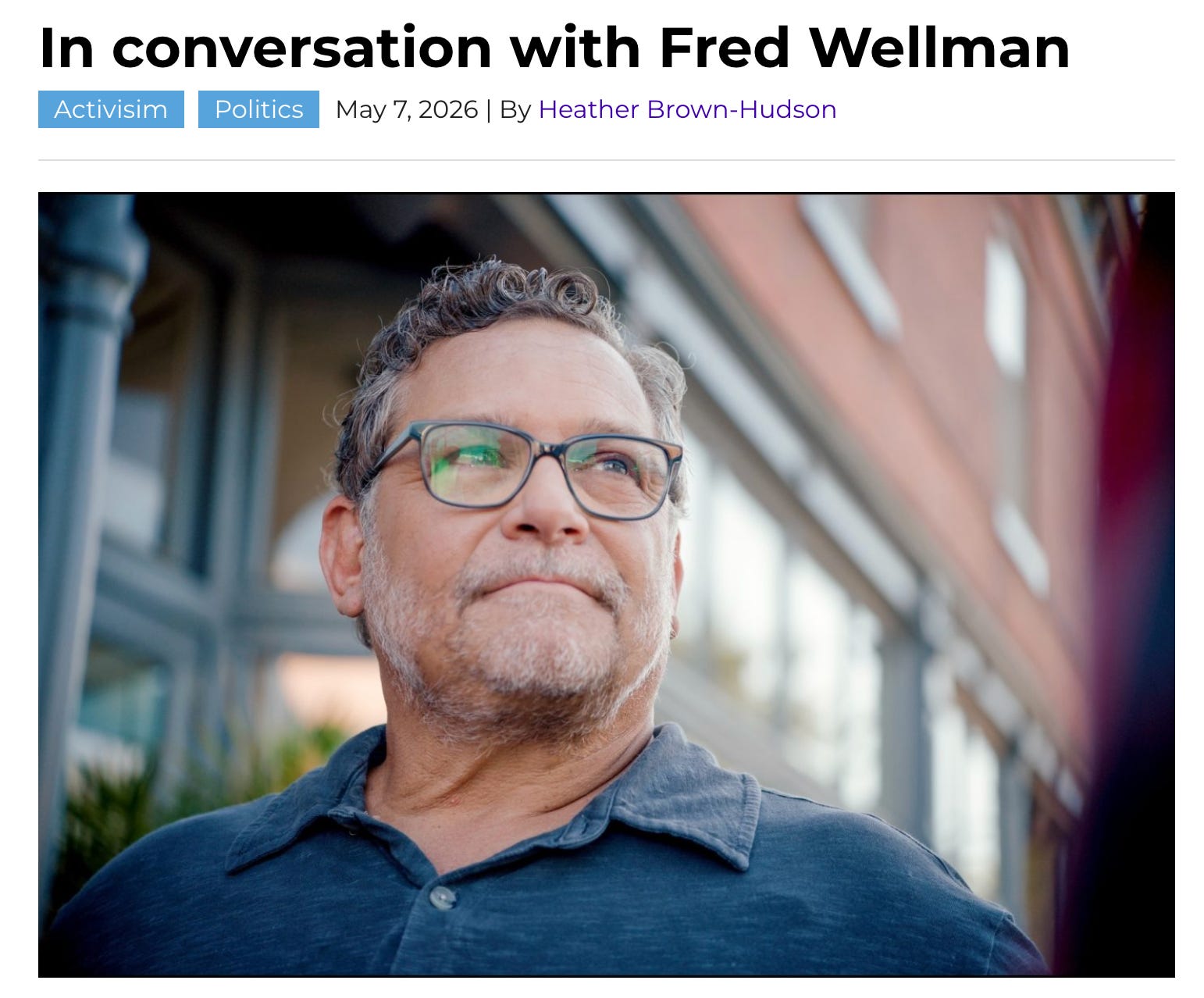
At a time when LGBTQ rights, especially those of trans Missourians, are under relentless legislative attack, it’s not unusual for candidates to show up, say the right words, and move on.
What’s less common is someone willing to sit in the discomfort of the moment—and stay there. In a political climate increasingly defined by polarization, Missouri’s 2nd District Democratic congressional candidate Fred Wellman is trying to return the conversation to something more fundamental: fairness.
In a recent conversation with Out In STL, when probed about key issues germane to the lives of LGBTQIA+ Missourians, Wellman didn’t attempt to position himself as a savior of the queer community. Instead, he kept returning to something simpler and harder to fake: a belief that the government has no business targeting people for who they are. “I start from a very simple place,” he says.
It’s a message that may sound basic, even obvious. He argues that the basics are exactly what’s been lost. “Just leave people the hell alone and let them live their lives,” he said. He doesn’t claim a queer identity. So in his transition from ally to advocate, he names his position plainly: a straight, white, cisgender man with a lifetime of structural advantages. But rather than sidestep that reality, he centers it.
“People like me have to stand up,” he said. “Because I’ve never had to fight just to exist. And a lot of people in this community still do.”
This awareness did not emerge in a vacuum. It was shaped by the proximity of LGBTQIA+ family members, friends, fellow service members, and by loss. He spoke candidly about a queer niece who struggled deeply and ultimately died of an overdose after enduring what he described as relentless hardship. “I won’t sit back and watch people go through that again,” he said. It’s a statement that lands differently in a state where queer and trans Missourians are not speaking in hypotheticals, but in survival strategies.
Wellman seems aware that the fear that queer communities regularly experience is not an abstract one. For many LGBTQ families here, the stakes are immediate. During the conversation, he shared a story that has stayed with him about a Missouri parent of a transgender child who keeps “go bags” packed in the car in case they need to cross into Illinois quickly. “I’ve never once in my life had to think about whether my rights would change if I drove across a river,” he said. “That’s happening right here.” Indeed it is. Families are leaving. Others are staying and bracing. Some are doing both, preparing exit plans while fighting to remain.
What stood out in this conversation wasn’t just that he knew this; it’s that he didn’t try to soften it. And while speculation about his past perspectives may raise questions for progressive voters, he doesn’t dodge the issue; he leans into it. “People change,” he said. “And they should.”
He points to personal experiences. He cites his daughter’s healthcare journey, his employees’ struggles before the Affordable Care Act, and the lives of people close to him—as catalysts for that change.
For queer audiences, the question isn’t just whether someone has changed. Rather, it is whether that change is durable. “This isn’t a talking point. This is who I am,” Wellman says.
One of the central tensions for any candidate in Missouri is how to speak about LGBTQ rights to a broader electorate that may be indifferent or openly hostile. In other words, how to speak to everyone without erasing anyone. “Don’t dilute the issue. Reframe it,” he says.
“This is about individual freedom,” he said. “About government overreach. About whether the state gets to decide who you are.” What was so interesting about this strategy is that it leans into language often claimed by conservatives – freedom, parental rights, privacy – but applies it directly to queer and trans lives. “The idea that the government is going to go after medical records or attempt to decide how a family raises their child – that should concern everyone,” he said.
The attempt to move LGBTQ rights out of the margins and into the center of broader civil liberties requires not only stalwart allyship, though. Having the appropriate voices in the room is also paramount. For many in the community, there is an understanding that allyship is not just about what you say; it’s about what can happen when you refrain from speaking on behalf of queer communities.
When asked directly how he avoids speaking over LGBTQ voices, particularly trans voices, he didn’t hesitate. “I don’t have that lived experience,” he said. “So I need to listen to the people who do.” He described a commitment to building policy not in isolation, but in conversation with community members, advocates, and subject-matter experts. “If I get something wrong, I expect to be told,” he added. “And I’ll adjust.” It’s a stance that may sound obvious, but as many readers know, it’s rarely practiced consistently in politics.
Perhaps the most pointed moment came when he addressed a pattern many queer voters have seen before: candidates who support LGBTQ rights until it becomes politically inconvenient. “You’ve seen it,” he said. “People who will throw the community under the bus just a little bit. Just one tire.”
He was clear that he does not intend to do that. “I’d rather lose the race than lose my values,” he said. It’s a bold claim. In Missouri, it’s also a test.
Fred Wellman is not running because he always dreamt of Congress, he says. He’s running because he felt staying on the sidelines wasn’t enough, especially with younger generations, including his own children, facing an uncertain future.
For the St. Louis’ queer community, the question is not whether candidates can say the right things. It’s whether they will show up, listen, and hold the line when it matters. Whether that translates into trust or votes is, as always, up to the community.
Heather Brown-Hudson is a higher education and philanthropy professional residing in Missouri’s 2nd Congressional District with her wife, two sons and three dogs.
All Men and women…and children
It’s time we take these issues head on and stop shrinking from the fight. I’m going to Washington D.C. to fight for the rights of all of my constituents. Not just the ones that look like me, love like me, or donated to me.
Everyone. That’s the job. Let’s send someone who gets that.
Learn more about my race for the Missouri 2nd Congressional District at our website: WellmanforMO.com.
Yes! And now with this stupid gerrymandering… I’m anxious to cast my ballot for you.
"I start from a very simple place. Just leave people the hell alone and let them live their lives,”
This.